
Walters discusses Door/Window/Stair projects in the atrium of the UF Architecture Building. Photo by Brittany Sosa, Fall 2011. 
Walters discussing first year studio projects. Photo by John Fechtel, Fall 2011. 
Walters on studio reviews at the University of Virginia School of Architecture, with Jennifer Akerman, Kevin Burke, and Pete O’Shea. Photo by Jose Atienza, 2009. 
Walters leading a drawing class at the German Pavilion by Mies van der Rohe in Barcelona, Spain. Photo by Francia Salazar, Spring 2016. 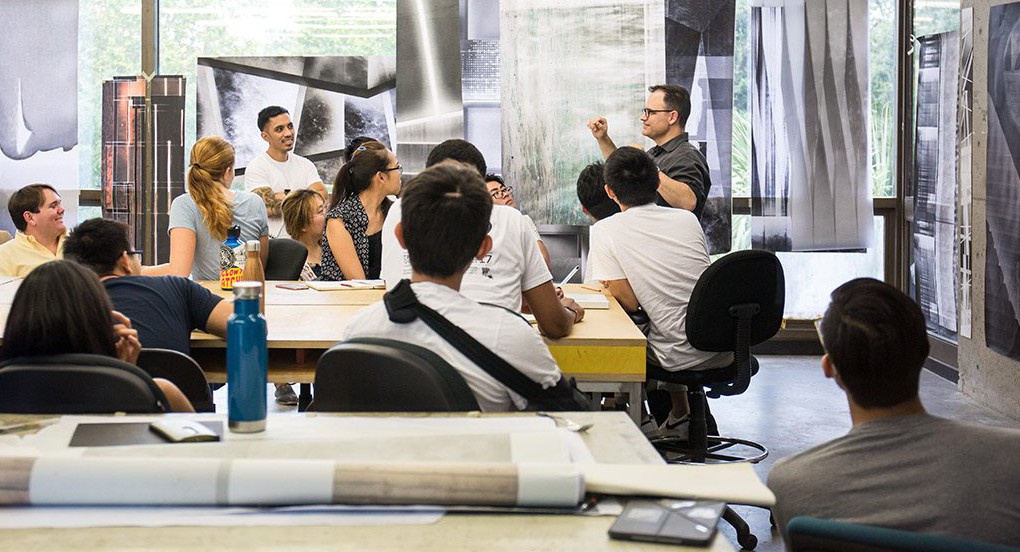
Walters leading a graduate design studio, Fall 2016. 
Walters and Solar Decathlon Team, Summer 2014. 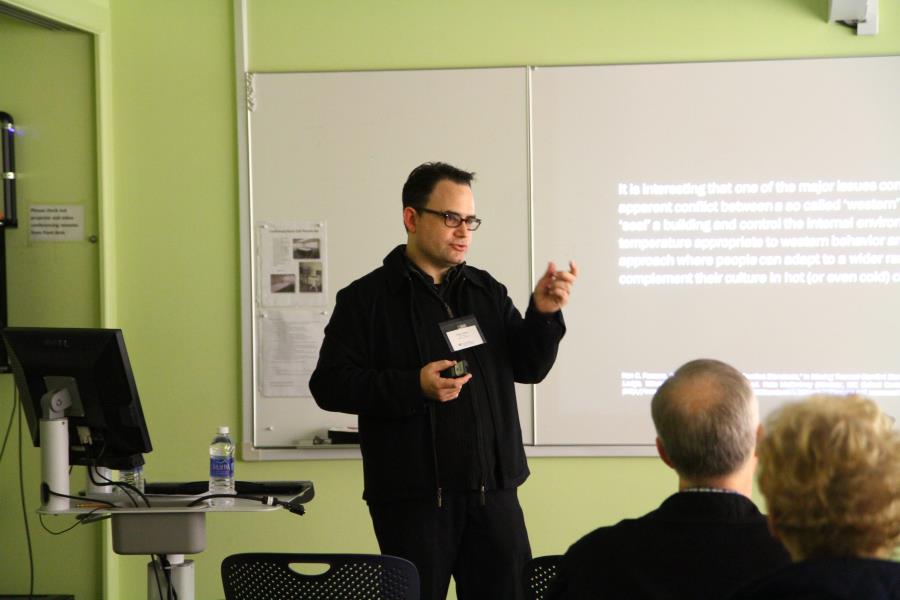
Walters presenting research on high-performance housing in Florida at the DCP Research Symposium, Spring 2014. 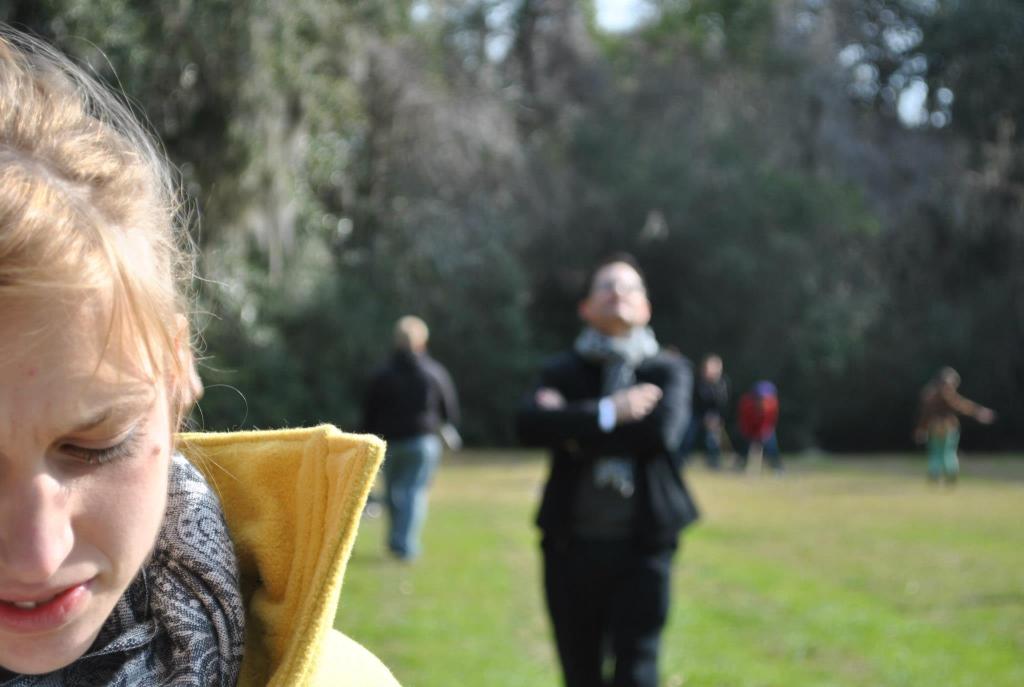
Walters leading a student tour at Middleton Place near Charleston, SC. Photo by Mitchell Clarke, Spring 2013. 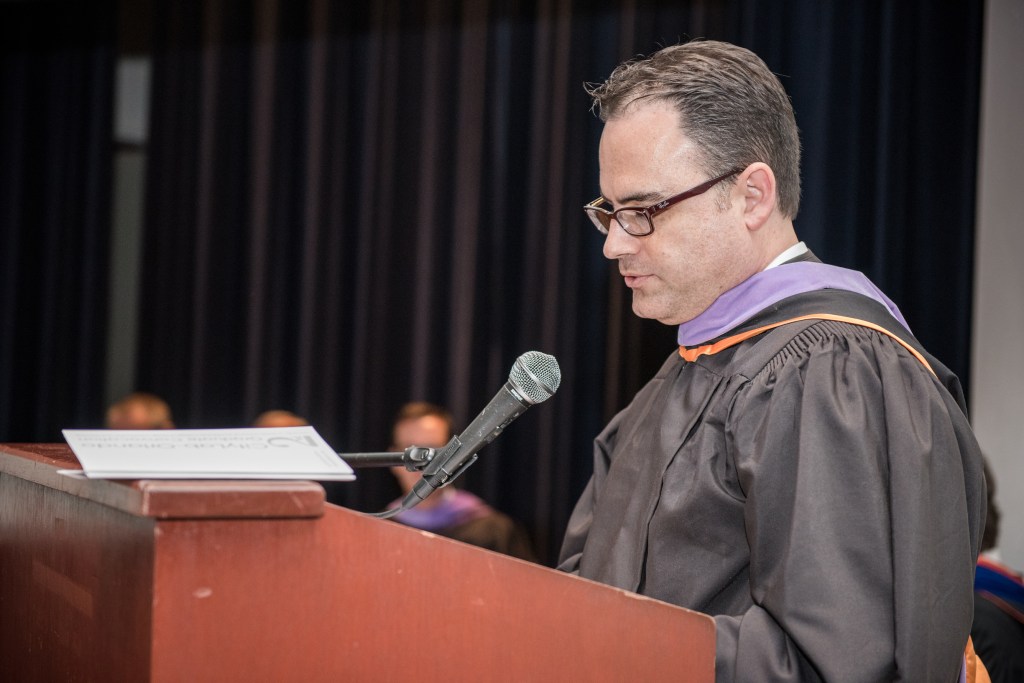
Walters addressing graduates at the Spring 2015 CityLab-Orlando Convocation. 
Walters celebrating graduation with Cristina Moreno and Professor Stephen Belton, Spring 2015. 
Walters with Solar Decathlon Team, Summer 2014. 
Walters discusses project work with undergraduate students in the atrium of the architecture building. Photo by Andrew Stanfill, Independent Florida Alligator, Fall 2008. 
Walters in studio design reviews. 
Walters in studio design reviews. 


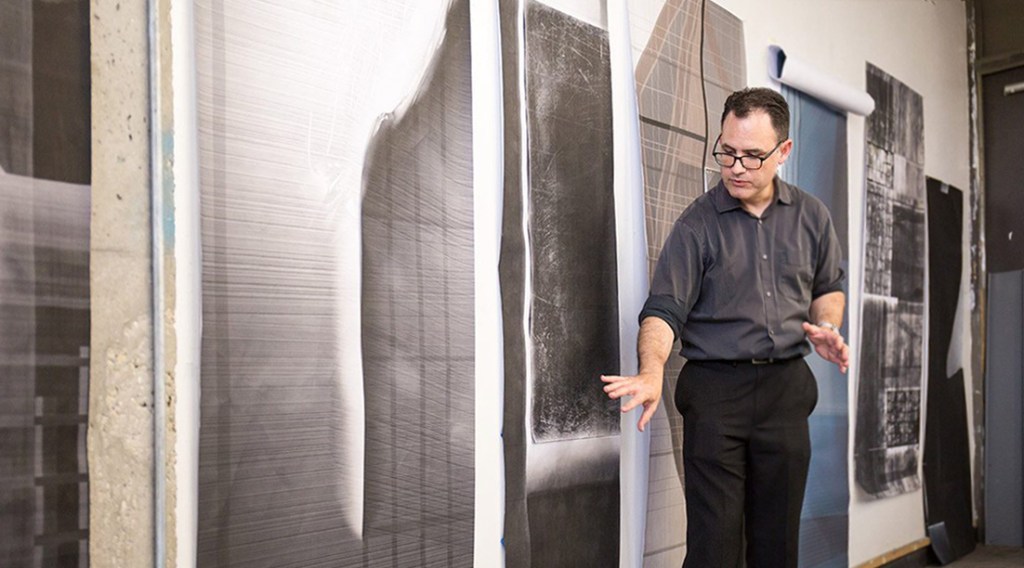
Walters discussing graduate student work, Fall 2016.
At the University of Florida, the normal semester teaching load for Mr. Walters includes two scheduled courses each semester, in addition to serving on Graduate Thesis and Dissertation committees. He serves as Honors Thesis Advisor for fourth-year undergraduate students, advises University Scholars, and serves on Capstone Project Review committees for students enrolled in the Bachelor of Science in Sustainability and the Built Environment (B.S.S.B.E.) degree program.
Design studios are the core of the School of Architecture’s pedagogical structure and are heavily weighted in both credit hours (4-6 per course) and in contact hours (8 hours per week in the first year and 9 hours per week starting in the second year of undergraduate studios). Most non-studio courses are 3- or 4-credit hours and involve 3- to 4- contact hours per course.
In addition to his 9-month per year appointment, he teaches the 6-credit Sustainable Planning and Design Studio that is a central component of the MSAS in Sustainable Design degree program. This course involves weekly studio sessions with students working remotely and field work in Singapore. Mr. Walters has taught or co-taught this course each year since 2011.
Building Bridges
As informational networks bind us ever more tightly together, they also introduce unseen gaps and fissures within fields of knowledge. While in some cases, these are the product of distraction or youthful naiveté, they are also symptomatic a field which is expanding both in breadth and depth through uneven specializations. The resulting disciplinary lacunae are extensive, with students asked to connect ever more remote points within unsettled and variable terrains. The impossibility of knowing and/or mapping these territories creates an ambiguous and amorphous field within which beginning design students are asked to find their way.
At a fundamental level, I believe that teaching is about building bridges with and for our students, bridges that operate between academic and professional worlds, between disciplines, between different modes of thinking and making, between scales (global/local and concept/detail), between hand and digital modes of working, and between and amongst a multiplicity of cultural/social/economic/sustainable motivators. To be an excellent, innovative, and effective teacher requires an understanding of how to make these bridges, and the ability to share that knowledge with others. It is equal parts knowledge and communication.
My work begins with our students, as complex, emergent people, each motivated in different ways and pursuing different trajectories, goals, and objectives. They are entering a design profession which is itself complex and at times contradictory, with no singular way of working within it or even describing it. The combination of these conditions establishes a variable field, within which there are many possible solutions to a given design problem.
Studio learning encourages dialogue, collaboration, risk-taking, innovation, learning-by-doing and the integration of knowledge. This model places a higher value on the search for constructive strategies of thought and action than on the direct transmission of knowledge and skills.
I believe it is important to teach our students an appreciation for open-ended, speculative thinking so that they are prepared for a lifetime of practice. And it is important for us to balance this with carefully-measured, analytic, problem-solving skills that will allow our students to appreciate the specificity required in their built work.
To the fullest extent possible, I teach by looking through my students’ eyes, seeking to always see their work both from the perspective of the site/context/discipline and from the perspective of the student/creator/thinker. I teach by asking questions, and I often draw while talking with and/or listening to my students. We swap pencils and pens, I navigate their digital projects on-screen, and together we work to clarify the project’s intent and the specifics of its realization. This bridging across scales within the work allows students to think about the detail and big idea simultaneously rather than compartmentalizing information.
In larger-format courses, I seek to understand concurrent curricular obligations and search for opportunities to cross-reference the subject matter between classes. I engage the students in the discussion with specific in-lecture examples, video shorts, and case-study images from my own built work and the work of others.
–
Courses Taught
Graduate
- DCP 6301 Sustainable Planning and Design Studio (Singapore)
- ARC 6241 Advanced Graduate Architectural Design One
- ARC 6355 Advanced Graduate Architectural Design Two
- ARC 6393 Advanced Architectural Connections
- ARC 6911 Architectural Detailing
- ARC 6913 Architectural Research 3 (MRP/Thesis Preparation)
- ARC 6940 Supervised Teaching
- ARC 6971 Masters Research Thesis
- ARC 6979 Masters Research Project
Published Ph.D. Dissertations – Committee Member: (3)
| Author | Year | Title | Publication | Degree |
|---|---|---|---|---|
| He, Chang | 2025 | Spiritual Space in Rustic Order | Doctoral Dissertation (Ph.D.)–University of Florida | Ph.D. |
| Kouhirostamkolaei, Mahtab | 2024 | Prospective Dynamic Life Cycle Assessment of Residential Heating and Cooling Systems in Four Different Climates in the United States | Doctoral Dissertation (Ph.D.)–University of Florida | Ph.D. |
| Sun, Ke | 2022 | The Flâneurs Dream World: A Phenomenological Dream Walk Through the Urbanscapes of Paris and New York City | Doctoral Dissertation (Ph.D.)–University of Florida | Ph.D. |
| Zeng, Ruochen | 2019 | Development of a Design System Based on Embodied Energy, Carbon Emissions, and Costs of Buildings in Early Design Phases | Doctoral Dissertation (Ph.D.)–University of Florida | Ph.D. |
Published Graduate Thesis / Project-in-lieu-of-Thesis (PILOT)
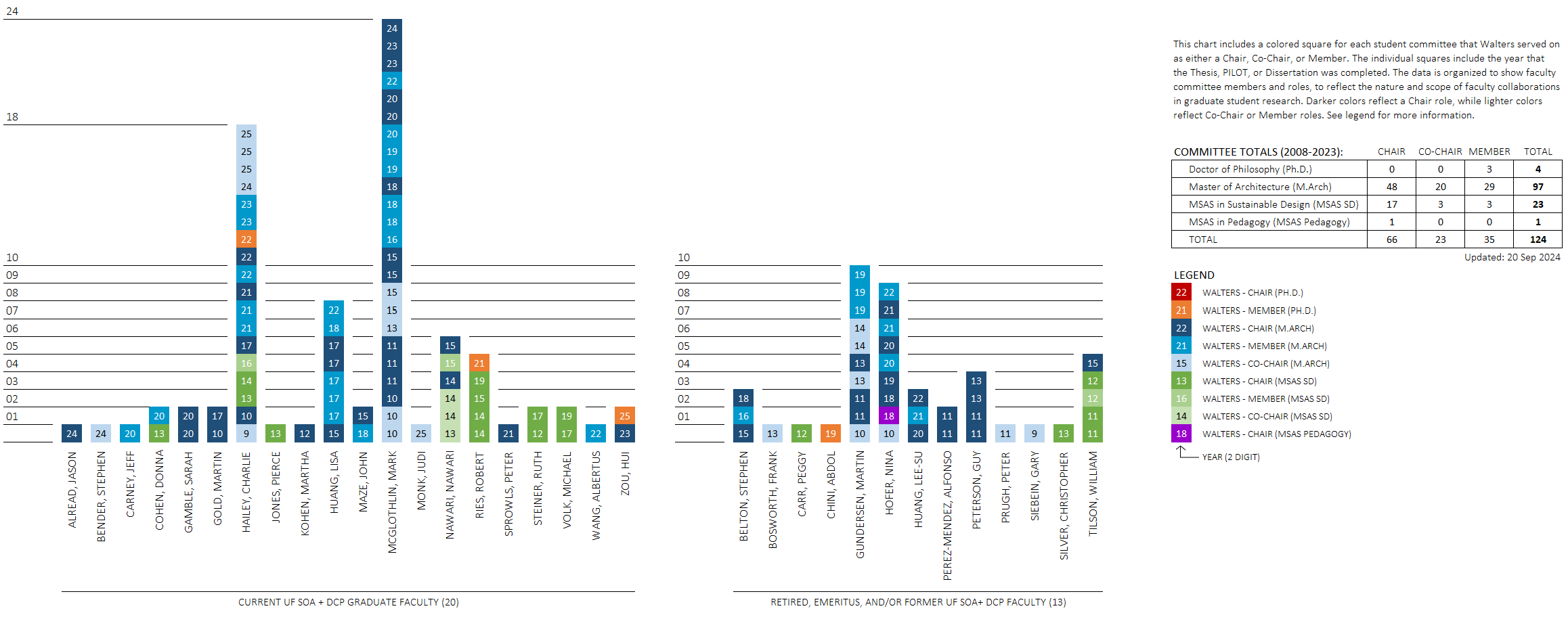
During academic years 2008-2023, Walters served on a total of 111 Graduate Thesis and/or PILOT Committees. Specific committee roles over these 15 years were as follows:
- Committee Chair: 63 Thesis and/or PILOT Committees (average of 4.2 committees per year)
- Committee Co-Chair or Member: 48 Thesis and/or PILOT Committees (average of 3.2 committees per year)
- Total: 111 (average of 7.4 committees per year)
Chair, Co-Chair, and Member Totals (2008-2023):
- Ph.D. = Doctor of Philosophy: 3
- M.ARCH = Master of Architecture: 88
- MSAS SD = MSAS in Sustainable Design: 22
- MSAS PEDAGOGY = MSAS in Pedagogy: 1
- THESIS = M.Arch or MSAS Thesis: 6
–
Faculty Thesis + PILOT Collaborations (2008-2023):
For graduate students, contemplating research trajectories:
Undergraduate
- ARC 1301 Architectural Design 1
- ARC 1302 Architectural Design 2
- ARC 2303 Architectural Design 3
- ARC 2304 Architectural Design 4
- ARC 2461 Materials and Methods of Construction 1
- ARC 3291 Analytic Drawing and Sketching (Vicenza, Italy)
- ARC 3320 Architectural Design 5
- ARC 3321 Architectural Design 6
- ARC 3463 Materials and Methods of Construction 2 (Vicenza, Italy)
- ARC 4073 Graduate Core Studio 3
- ARC 4074 Graduate Core Studio 4
- DCP 4290 Capstone Project in Sustainability and the Built Environment
- ARC 4322 Architectural Design 7
- ARC 4323 Architectural Design 8 (Gainesville, Florida and Vicenza, Italy)
- ARC 4323 Integrated Project Delivery Studio and Practicum
- ARC 4941 Educational Teaching Issues
Published B.S.S.B.E. Capstone Project – Faculty Advisor: (2)
- White, Alyssa. 2015. Sustainable Materials: For Zero-Waste Design: Discovering Alternative Materials for the Future of Zero Waste Architecture.
- Huber, Katherine. 2010. A Path to Sustainable Construction: Modular Techniques and Environmental Drivers Behind Materiality.
Published Undergraduate Honors Thesis – Faculty Advisor / Mentor: (29 total)
2020-2021 (5)
- Bergeron, Natalie. 2021. The Memory of a City: The Reintroduction of Farmlands in Manhattan.
- Gooch, Elizabeth. 2021. The Art of Stillness in Architecture.
- Martucci, Clara. 2021. Designing Cities through Sound: A Comparative Study of Urban Spaces and Soundscapes.
- Operta, Merlina. 2021. Places for People: Reconsidering the Metropolis.
- Roberts, Stephanie Rose. 2021. The Human vs. The Machine: How Urban Palimpsest or Erasure Impacts Societal Endeavors and Placemaking.
2018-2019 (2)
- Restieri, Ryan C. 2019. Vital Urban Architecture: Parcel, Transportation, and Communication.
- Wiedenhoever, Laura. 2019. Inside-Out: Investigating Energy Efficient Facades.
2015-2016 (8)
- Savignon, Ivy. 2016. Lack of Place: Urban Wastelands as Catalytic Opportunities for Urban Growth and Social Interaction.
- Kokenge, Samantha. 2016. Designing Digitally: Ornament or Advancing Architecture.
- Nichols, Graham Isaac. 2016. Produce to the People: Solutions for Manhattan’s Food Deserts.
- Whitbeck, Emily. 2016. The New York City Grid: Impediment or Opportunity for Innovation in Architecture.
- Tran, Anh. 2016. Habitable Station: Refocus on Spatial Qualities of Civic Nodes in Public Domain.
- Benitez, Adiel Alexis. 2016. Drawing Out Suggestions of a Possible Architecture: Drawing and Speculation In Pursuit of Architectural Solutions.
- Rutland, Sarah. 2016. Public Space: Architecture as a Library, Mirror, and Lighthouse.
- Marblestone, Kevin. 2016. A New Infrastructure: Establishing a Culture of Resilience and Civic Engagement.
2011-2012 (7)
- Hiller, Anastasia. 2012. Architecture Representation: Abstraction and Symbol within Design.
- Ho, Huynh. 2012. People as Context.
- Jones, Abigail. 2012. The Layered City: Streetscape as Differing Layers of Engagement within the Metropolis and its Buildings.
- Mudenda, Muchanga. 2012. Shaping Public Space: The Modern Day Courtyard.
- Pace, Jessica. 2012. Technology and Digital Form: Obsolescence vs. Relevance.
- Tao, Yifan. 2012. Redefining the Urban Condition: Relationships within the Built Environment.
- Tracy, Matthew. 2012. The Puzzle of Architecture: The Network of Pieces: Joints, Journey, Parts.
2010-2011 (3)
- Ala, Justine. 2011. The Phenomenology of Projection.
- Bittner, Hana. 2011. Urban Kinematics: Interpreting Urban Scripts and Deconstructing Systems of Living.
- Schafer, Challie. 2011. The Urban Palimpsest: Constructing a Sense of Place Through Experiential Layers.
2009-2010 (4)
- Chu, Katherine. 2010. Urban Viewing: Rethinking Relationships through the Built Environment.
- de Solo, Enrique. 2010. The Design Process: A Search for Originality Amongst Existing Archetypes.
- Hurcomb, Melissa. 2010. Redefinition of Urban Viewing and Interaction through an Architectural Framework.
- Levin, Danielle. 2010. New York City Block.
University Scholar Mentor + Faculty Advisor: (4)
- Martucci, Clara. 2021. Designing Cities Through Sound: A Comparative Study of Urban Spaces and Soundscapes. Vol. 23 (2021): UF Journal of Undergraduate Research. https://journals.flvc.org/UFJUR/article/view/128400. Scholar Profile: https://cur.aa.ufl.edu/portfolio/clara_martucci/
- Kyesmu, Panquat. 2016. The Preservation of Memory: Germplasm Repository in the Tropics.
- Clarke, Mitchell. 2014. Link between Spatial Design and Social Responses in Student Housing.
- Monroe, Marcy. 2010. The Economic and Political Influence on Natural Disaster Recovery: Rebuilding After the 2008 Sichuan Earthquake in China.
United World College Scholars Program + Kathryn W. Davis Projects for Peace – Faculty Advisor: (1)
- Misuraca, Jeanette and Djoni Austin. 2017. Tarpon Excelling Above Modern Society (T.E.A.M.S.). United World College Scholars Program + Kathryn W. Davis Projects for Peace, Middlebury College, Middlebury Vermont. Award profile: http://www.davisprojectsforpeace.org/projects/projects/2017/node/4878. Project page: https://www.middlebury.edu/projects-for-peace/projects/2017/tarpon-excelling-above-modern-society-teams.
 BRADLEY WALTERS ARCHITECT