Bradley Walters
University of Florida, Gainesville FL, U.S.A.

EDITOR’S NOTE: This work was first presented by Bradley Walters at the Ukrainian Library Association’s 27th Nationwide Conference “Korolenko Readings 2024: Libraries, Archives, and Museums in Times of War,” Kharkiv UKRAINE, 24-25 October 2024.
The work was subsequently revised and expanded for inclusion in the peer-reviewed proceedings. The publication citation is as follows:
Walters, Bradley. 2024. “Architecture of Culture, Community, and Climate: A Library for Kherson, Ukraine,” XXVII All-Ukrainian Online Scientific and Practical Conference, KOROLENKO’S READINGS “Libraries, Archives, Museums in Wartime,” Kharkiv UKRAINE, October 24–25, 2024. Publication, pages 96-119.
The presentation and subsequent publication included project work by: Kylie Eubanks, Christopher Fettes, Micah Fitzgerald, Aaron Karr, Colby Marcoux, Juan Miri, Hunter Oropeza, Davison Oser, John Eric Phipps, Tessa Register, Jamilah Roman, Vincent Boone Schroder, and Sofia Sousa.
Анотація. Представлено проєкт відбудови Комунального закладу «Херсонсьа обласна універсальна наукова бібліотека імені Олеся Гончара» Херсонської обласної Ради, пошкодженого внаслідок збройної агресії Росії проти України, який розробила команда Коледжу дизайну, будівництва та планування Університету Флориди у США.
Ключові слова: Україна, культура, російсько-українська війна, збереження знань, Університет Флориди у США, місія Коледжу дизайну, будівництва та планування, Херсонська обласна універсальна наукова бібліотека імені Олеся Гончара, проект відбудови бібліотеки, ландшафтний дизайн.
Abstract. A project for the reconstruction of the Municipal Institution «Kherson Regional Universal Scientific Library named after Oles Honchar» Kherson Regional Council, damaged as a result of Russia’s armed aggression against Ukraine, was presented, developed by a team from the College of Design, Construction and Planning of the University of Florida in the U.S.A.
Keywords: Ukraine, culture, Russian-Ukrainian war, preservation of knowledge, University of Florida in the USA, mission of the College of Design, Construction and Planning, Oles Honchar Kherson Regional Universal Scientific Library, library reconstruction project, landscape design.
It is a time of war in Ukraine. There is an immense sense of loss at present—the loss of life, of land, of livelihood, of knowledge, and of peace. The future of this place and of this people is unwritten. This research recognizes the long history of the country, the region, the people, and the current human tragedies. We acknowledge the complex and interwoven histories of Ukraine, Russia, and their regional neighbors. We approach this project with humility and deep respect for the people of Ukraine. We wish to honor the many sacrifices and ongoing struggles of the people.
It is also a complex time for libraries, in a time of digital media, where the archive becomes both more important and less so. What is a library in this time, and in this place? How might we contribute to the work of preserving knowledge and sustaining culture during a time of war? In response to the current conflict and changing roles of libraries, this research involves the design of a library for Kherson, Ukraine.
Project Team
The project team was led by Associate Professor Bradley Walters, AIA, from the University of Florida School of Architecture in Gainesville, Florida U.S.A. In addition to Mr. Walters, team members included Kylie Eubanks, Christopher Fettes, Micah Fitzgerald, Aaron Karr, Colby Marcoux, Juan Miri, Hunter Oropeza, Davison Oser, John Eric Phipps, Tessa Register, Jamilah Roman, Vincent Boone Schroder, and Sofia Sousa.
The University of Florida (UF) is a public research university based in Gainesville, Florida, U.S.A. UF articulates its mission as «three interlocking elements» of teaching, research/scholarship, and service. These elements “span all the university’s academic disciplines and represent the university’s commitment to lead and serve the state of Florida, the nation and the world by pursuing and disseminating new knowledge while building upon the experiences of the past” (UF Mission Statement).
The School of Architecture is one of three schools within the College of Design, Construction & Planning (DCP) at the University of Florida. The college excels in providing hands-on learning opportunities for students. The mission of DCP is to improve the quality of the built and natural environments through offering exceptional educational and professional programs and research/scholarship initiatives that address the planning, design, construction, and preservation of the built and natural environments.

Figure 1. Comparative diagrams showing the relative sizes of Ukraine and Florida, side-by-side with one another, along with a diagram showing the geographic distance (9,312 km) between Kherson, Ukraine and Gainesville, Florida USA. Images by Bradley Walters.
To help our project team to understand Ukraine and to help the people of Ukraine to understand Florida, we put together comparative diagrams showing the relative sizes of Florida and Ukraine, side-by-side (Figure 1). Ukraine is approximately 4.3 times larger than Florida. [1] Florida is 139,670 sq km in area, while Ukraine is 603,550 sq km in area. Ukraine is 332% larger than Florida. The population of Florida is approximately 18.8 million people compared with approximately 38 million people in Ukraine. [2] Areas under Russian Control are from mappings provided by the Institute for the Study of War (ISW). [3]
About the Library
Founded on 18 June 1872, the Oles Honchar Kherson Regional Universal Scientific Library was one of the first publicly-accessible book collections in Ukraine. By 1941, the library’s book collection numbered more than 300,000 volumes, and was used by almost 10,000 readers. During the fascist occupation, the library was looted and more than 215,000 books were destroyed. Following the end of World War II, the library was gradually rebuilt during the Soviet period, becoming one of the most modern scientific libraries in Ukraine. In the late 1980s, the old building from the Russian Empire era was replaced by a new one on the banks of the Dnipro River, where the library relocated in 1987.

Figure 2. Undated archival photo of the Oles Honchar Kherson Regional Universal Scientific Library. Image source: https://www.rferl.org/a/ukraine-destroyedmonuments-architecture-day/32618791.html

Figure 3. Oles Honchar Kherson Regional Universal Scientific Library, Park Slavy, Arestanka Quay, and the Dnipro River. Source: Undated aerial photograph from Google, with additions/edits by Bradley Walters.

Figure 4. Aerial photograph of the Kherson Library, Arestanka Quay, Dnipro River, and surrounding neighborhoods, 13 April 2017. Image source: AdobeStock_151899825.jpeg by operator1975, Adobe Stock (education license)

Figure 5. Undated photo of the façade of Oles Honchar Kherson Regional Universal Scientific Library, with dimensional annotations by Bradley Walters. Image source: https://censor.net/en/news/3380142/russian_occupiers_took_away_priceless_funds_from_kherson_library_director_korotun

Figure 6. Diagrammatic building and site section drawing, showing the existing library in relationship to Arestanka Quay and the Dnipro River. Image by: Bradley Walters / University of Florida.
The current Russo-Ukrainian war began on 24 February 2022, when the Russian government launched the largest ground military campaign in Europe since World War II. Given that the war targets the cultural identity of the Ukrainian nation, many of the invading forces’ targets have been cultural institutions—museums, archives, libraries, and cultural centers. The Kherson Library has been the subject of numerous attacks and has been intermittently occupied by Russian forces. Following shelling and an ensuing fire in November 2023, the building has been described as largely destroyed.
While it was not possible for our project team to visit the structure, conduct independent assessments, and document current conditions in detail, the team studied numerous photographs posted online over the course of the current conflict and in recent months. The most recent images show significant damage to the building. There is evidence of large missile impacts and artillery shelling, as well as localized fires within the structure. There is evidence of structural damage in several locations, especially on the southeast-facing façade, overlooking the Dnipro River. This side of the building has received significant impacts from artillery fire. Local residents and library staff have acknowledged that the structure and its contents have been compromised, possibly beyond repair. (Figures 7, 8).

Figure 7. Extensive damage to Oles Honchar Kherson Regional Universal Scientific Library. Image posted by Tetyana Teren, 12 November 2023. Image source: https://www.facebook.com/tetyana.teren/posts/pfbid0UkaE9aBmtXYNHLBrgRvjQJ6FgL6dwzGQKoR7xwtJ2SrXZDJHWGMk3etoehmTu7tJl

Figure 8. Oles Honchar Kherson Regional Universal Scientific Library. Image posted by Гюндуз Мамедов / Gyunduz Mamedov @MamedovGyunduz, 12 November 2023. Source: https://x.com/MamedovGyunduz/status/1723629818644684992/photo/1
Methodology
The current research work was completed as part of required graduate design studios in the Master of Architecture (M.Arch) degree program at the University of Florida School of Architecture.
Building on preparatory undergraduate or graduate work, Advanced Studio 1 (“G1”) introduces students to the challenges and rigors of developing a philosophical position and research-based design process as the foundation for a career in architectural design and practice. Emphasis concentrates on cultivating self-directed speculation, analytical thinking, and synthetic design exploration within the framework of an organized studio program. The framed program anticipates incorporating multiple trajectories offered by companion courses both within and beyond the School of Architecture and students are encouraged to draw from this knowledge. Students are expected to develop their ideas philosophically, conceptually, and architecturally to provide a strong foundation in critical thinking and architectural design. Students are encouraged to use this course to germinate scholarship and personal perspectives that will be expanded in future studios and the Thesis or Project-in-lieu-of-Thesis (PILOT).
Architecture is shaped by a number of competing and often contradictory forces. Social and historical considerations challenge architecture to be meaningful to its time and its place. Consideration of users and their programmatic requirements involve human factors and a range of physical abilities, accessibility requirements, life-safety concerns, and cultural referents. Consideration of site and context requires careful understanding of climate, environmental conditions, variable weather and/or climate concerns, and numerous performance-based aspects of building. Responding to racial inequalities requires a nuanced understanding of history and culture in how we make design decisions. And concerns for environmental health and justice require a careful understanding of the measurable environmental impacts of design decisions.
Advanced Studio 3 (“G3”) is the final course in the graduate design studio sequence, leading into the final thesis or PILOT work in the final semester. As a result, the G3 studio becomes a hinge between the collective and the individual with regards to theme, research, and potential collaboration. We will take full advantage of this curricular position to develop work throughout the semester that is both of great personal interest and contributes to collective knowledge, discussion and creative work. Building on the comprehensive aspects of Advanced Studio 2 (“G2”), G3 allows greater freedom in the scope and detail of design work produced. Students are asked to use the advanced set of skills and techniques that they have developed over their graduate and undergraduate careers, while being open to experiment in the design process and explore new areas of knowledge through research. Hybrid processes are encouraged, particularly in working back and forth between digital and analog. Students are expected to develop their own voice in techniques, design language, and conceptualization, with the expectation that work is done with a high level of rigor.
During the fall 2024 semester, vertical design studios included students in both Advanced Studio 1 and Advanced Studio 3. Each of the four (4) Gainesville-based vertical design studios addressed identical curricular goals while working with diverse project programs, sites, and approaches. For all of the studios, readings, case studies, and introductory exercises served as catalysts to provoke a sequence of investigations and establish issues to be addressed throughout the term. Research and analysis, framed and reframed through design synthesis, provided an intellectual foundation from which the studio developed architectural responses to program, place, and time.
Project work investigated spatial and material relationships between insides and outsides, negotiating the complexities of a rich program and site at the building scale. While centered on materiality and the tectonics of construction, we also sought opportunities to engage history, socio-cultural relationships, phenomenology, and ecology in our work. Students were charged with developing philosophical approaches that could be transformed into and through architecture.
Phase 1: Materiality + Detail – 1 week
The project work started with an exercise focused on materiality and detail. Assigned readings included The Tell-the-Tale Detail by Marco Frascari (1984) and Terrible Beauty 2: the ineffable by Lebbeus Woods (2010).
Students were asked to create speculative, full-scale (1:1) drawings that were positioned in relation to the human body. Drawings were required to dynamically express materials, layers, assemblies (seams, overlaps), design intent (narrative, light and shadow), a range of scales (fasteners to large-scale surface textures), and measure. Students were challenged to engage opacity and/or transparency in their drawing studies.
This first set of drawing studies were conceived as a portion of an implied larger design project. Students were specifically asked to develop their drawings as a fragment of a façade, separating interior and exterior spaces. The drawing was required to suggest how a multi-layered building envelope might negotiate the relationships between people inside and outside a building. Students were asked to develop ideas and narratives to drive their design intent. Central to the drawing constructions was light. Students were asked to program their drawings to shape, transmit, and/or regulate natural light. They were asked to consider the shaping of light, including quality, color, texture, grain, scale, etc. Drawings were to incorporate transparent, translucent, and/or opaque areas, communicating light conditions, material surface qualities, and implied depth.
Finally, these drawings were required to include at least a portion of one or more apertures. Students were asked to address associated issues of views that might be allowed, denied, shaped, and/or directed. They considered systems that allow for a range of different scales of apertures. Students presented and discussed their full-scale drawing constructions, describing the spatial conditions that they were developing to begin to test possibilities for the Library in Kherson. Proposals engaged a range of issues surrounding libraries in a time of war, including time, memory, safety/security, knowledge archives, permanence, and loss.

Figure 9. Drawing and assembly studies by Christopher Fettes. Photographs by Bradley Walters.
Phase 2: Tectonic Experimentation + Frameworks – 3 weeks
During this phase of work, students were asked to consider the studio prompt, ideas of this place and its particular geographic, social, historical framework. The students were asked to consider ideas of “the library” and the roles of ideas, meaning, and knowledge. As with the prior drawing exercise, students were asked to work in a speculative manner to create materially-specific assembly proposals. The following prompts were provided as reminders:
- Design intent is important. How do you engage the particulars of Kherson, its residents, and the library program, at this moment of history and in light of recent and ongoing struggles?
- Even though we haven’t yet created full building proposals, consider this exercise as if it were a portion of a larger design project. It should be developed as a fragment of a façade, separating interior and exterior spaces. The work should suggest how a multi-layered building envelope might negotiate the relationships between people inside and outside a building.
- Consider light. Assemblies should shape, transmit, and/or regulate natural light. Consider the shaping of light, including quality, color, texture, grain, scale, etc. Incorporate transparent, translucent, and/or opaque areas. Study light conditions, material surface qualities, and implied/actual depth.
- Consider one or more apertures. Address associated issues of views that might be allowed, denied, shaped, and/or directed. Consider systems that allow for a range of different scales of apertures.
In this exercise, students worked to translate their ideas and drawing studies into three-dimensional form, with an eye towards building assemblies that could meet their design objectives. Students created a series of physical model studies (three to five, or more). These model studies were used to study and develop assemblies that shaped light, negotiated social relationships, and convey meaning. The models were considered as principally vertical assemblies (walls) and/or overhead horizontal assemblies (roofs/ceilings/floors), negotiating insides and outsides.
Building on their tectonic assembly studies, students then created three-dimensional “corner conditions” for their proposed construction. Students were asked to engage the intersection of two vertical conditions and an overhead and/or a ground condition. This phase of work was primarily centered on physical model constructions. Students engaged numerous materials, including 3D printing for certain components based on model scale. The work engaged structural hierarchies, from primary to secondary to tertiary, etc. Students were challenged to create clear and discernable structural logics. Finally, the projects had to consider steel building systems, including lattice structures, mechanical joints, building envelopes, and surface possibilities.

Figure 10. Material, assembly, and light studies by John Eric Phipps. Photographs by John Eric Phipps and Bradley Walters.

Figure 11. Drawing and assembly studies by Jamilah Roman. Drawings by Jamilah Roman; Model photographs by Jamilah Roman and Bradley Walters.

Figure 12. Drawing and assembly studies by Davison Oser. Drawings by Davison Oser; Model photographs by Bradley Walters.
Phase 3: Provocations + Place-Making – 4 weeks
During this phase of project work, students were asked to conduct collaborative site and environmental research in two- and three-person teams. The students self-organized and identified the following broad areas for further study: 1) history and culture, 2) climate, 3) demographics, 4) topography and geography, 5) zoning, and 6) transportation. Each of the teams shared their findings with the rest of the class, to create a shared body of research that the entire team could use to further develop project work.

Figure 13. Drawing studies by Christopher Fettes. Annotations and photographs by Bradley Walters.

Figure 14. Drawing studies by Vincent Boone Schroder. Photographs by Bradley Walters.

Figure 15. Drawing studies by Micah Fitzgerald.

Figure 16. Drawing studies by John Eric Phipps.

Figure 17. Drawing studies by Davison Oser.
While most of the students decided that the current structure was compromised beyond repair, a few of the students worked to rehabilitate the existing structure through renovations, repairs, and new interventions. These proposals created a dialogue between old and new. In some cases, the scars of war were retained intentionally as voids within the building or as wounds that were spaces for contrasting interventions. Gardens, populated by native plantings, were engaged to create spaces of quiet reflection and memory within a re-energized and rehabilitated library structure.

Figure 18. Drawing studies by Jamilah Roman.

Figure 19. Drawing and model studies by Kylie Eubanks.
Phase 4: Testing + Revising + Developing Proposals – 6 weeks
Over the last weeks of the semester, students worked aggressively to resolve their formal/spatial ideas. Students were asked to develop drawings and physical model studies to test their design approaches in three dimensions.

Figure 20. Model study by Christopher Fettes.

Figure 21. Drawing study by Hunter Oropeza.

Figure 22. Model study by Tessa Register.

Figure 23. Sectional drawing study by Vincent Boone Schroder.

Figure 24. Drawing studies by Vincent Boone Schroder.
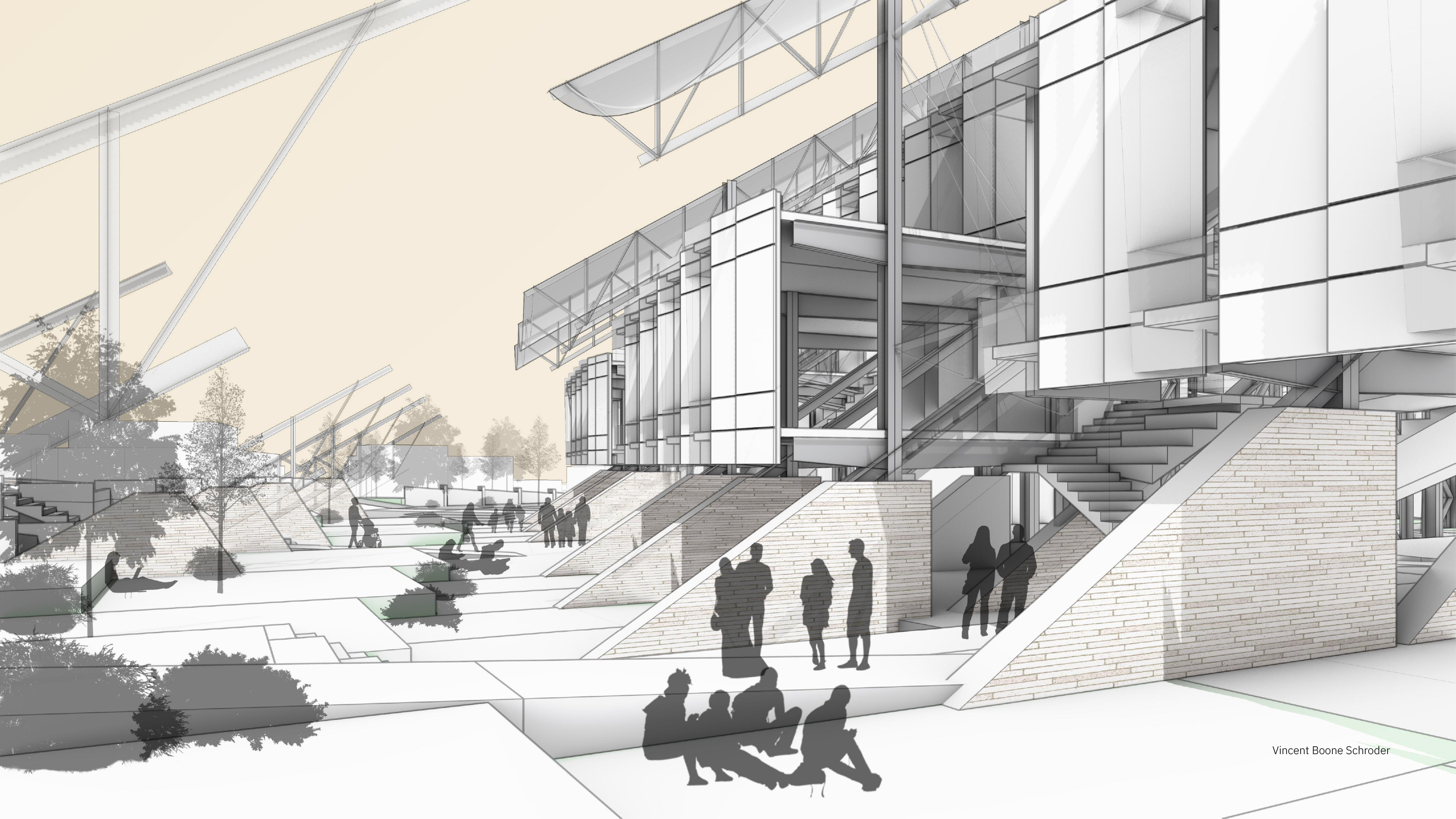
To describe his approach to the project, Vincent Boone Schroder reflected on the contested histories of Ukraine over many centuries, and of course, the ongoing conflict with Russia. His proposal, titled “the Library of Mending Fragments,” was intended to recognize Ukraine’s struggles. Schroder noted that “the fragmented form, large glass curtain walls, flexible fabric tensile roofs, and a heavily filigree construction style represent an architecture that is trying to find itself.” His proposal reflects these contested formal and spatial qualities.

Figure 25. Drawing studies by Aaron Karr.
In his expansive, landscape-oriented proposal, Aaron Karr focused on community. His description of the project noted that “the library’s role as an educational and cultural hub will empower individuals with knowledge, creativity, and resources for personal and professional growth, while the community and retail spaces will provide opportunities for social interaction, collaboration, and local entrepreneurship.” He created a series of outdoor gathering areas and a farmers’ market that “will not only revitalize the local economy by supporting small businesses and artisans but also create a lively space for traditions and cultural events to flourish.” Finally, “the design’s thoughtful integration with the natural landscape will remind the community of their resilience and the beauty of their surroundings, offering hope and a shared vision for the future. Together, these elements will help rebuild the social fabric of Kherson, transforming a site once marked by loss into a beacon of unity, progress, and resilience.”
Reflection
“Place is meaningful to people, and the place called home is the most meaningful of all. When it is threatened, we are roused to defend it. We also learn that home is not simply one’s dwelling, but can also be one’s homeland or native region. It is one of the obvious facts of life, so often overlooked, that people are not merely attached to other people but also to familiar objects, structures, and environments that nourish the self, support the continuity of life, and act as props to memory and identity.” [4]
Libraries are important cultural repositories, and they are part of what defines Kherson as home for the people of this region. Our team recognized the tremendous loss caused by the war as well as the opportunities for libraries to serve as places of collective memory and national identity. Our project team spent a great deal of time learning about Ukraine, and about Kherson in particular, to try to be as sensitive and responsive as possible to the very real needs of the residents. In addition, we considered issues of culture, war, heritage, memory, panopticon, power, censorship, control, history, ethnographic, weeding, domicide, identity, assimilation, postcolonial lacuna, mimicry, hybridity, prison, ambivalence, palimpsest, propaganda, loss, resistance, occupation, symbol, language, metaphor, meaning, autonomy, society, information, and surveillance.
Given the ongoing conflict, the story of the Kherson library is one that continues to be written, and there is no comprehensive or final conclusion to report at this time. The team from the University of Florida was unable to benefit from immersion within the richness of Ukrainian culture. We learned a great deal, but we still recognize the inadequacy of our approach to date. The team was also insulated from the direct horrors of war. As a result, the proposals developed are at best incomplete and partial, contingent on further understanding and input from librarians, community leaders, and neighbors. We hope to have an opportunity to continue this important work, hopefully in a time of peace that cannot come soon enough for the people of Ukraine.
Notes
[1] https://www.mylifeelsewhere.com/country-size-comparison/ukraine/florida-usa
[2] https://www.worldometers.info/world-population/ukraine-population/
[3] https://storymaps.arcgis.com/stories/36a7f6a6f5a9448496de641cf64bd375
[4] Porteous, J. Douglas and Sandra E. Smith. (2001). Domicide: The Global Destruction of Home. London: McGill-Queen’s University Press, 6.
List of Bibliographic References
- –. History of the library: the path from public to scientific / Kherson Regional Universal Scientific Library named after Oles Honchar. https://lib.kherson.ua/en-history.htm
- –. “The Russian army destroyed a well-known library in Kherson” (12 Nov 2023), The Odessa Journal. https://odessa-journal.com/the-russian-army-destroyed-a-well-known-library-in-kherson
- Bruy, Oksana and Oleg Serbin. (2024). “Statement from the Ukrainian Library Association and Yaroslav the Wise National Library of Ukraine: Vision of the future of Ukrainian libraries for post-war recovery, human capital development, and economically strong and democratic Ukraine.” https://ula.org.ua/novyny-ta-podii/novyny/5262-bachennia-maibutnoho-ukrainskykh-bibliotek-dlia-pisliavoiennoho-vidnovlennia-rozvytku-liudskoho-kapitalu-ta-ekonomichno-sylnoi-i-demokratychnoi-ukrainy
- Frascari, Marco. (1984). “The Tell-the-Tale Detail.” In VIA 7: The Building of Architecture, 22-37. Philadelphia: University of Pennsylvania and MIT Press.
- Gosart, Ulia and Liudmyla Diadyk. (2023). “The Role of Ukranian Libraries in Preserving Cultural Heritage During Wartime,” IFLA WLIC 20223 Rotterdam Satellite Meeting: Strengthening libraries emergency preparedness and response. 17-18 August 2023, Amsterdam, The Netherlands. https://repository.ifla.org/server/api/core/bitstreams/26691c0a-9369-4764-bf5e-6327b3d632bd/content
- Gosart, Ulia and Rachel Fu. (8 March 2024). “Why Suppression of Libraries Corrupts a Nation | Backtalk.” Library Journal (LJ). https://www.libraryjournal.com/story/why-suppression-of-libraries-corrupts-a-nation-backtalk
- Karlsson, Emanuel. (2024). Ukrainian Libraries at War: Contesting Colonial Heritage in Western Ukraine, Supervised by Christer Eld, Lecturer at Department of ALM, Uppsala Universitet (SWEDEN). https://uu.diva-portal.org/smash/get/diva2:1879210/FULLTEXT01.pdf
- Matthews, J. (2024). “Guest Editorial: The War in Ukraine – a Librarian’s Perspective.” Public Library Quarterly, 43(4), 435–443. https://doi.org/10.1080/01616846.2024.2319911
- Pavylshyn, Olesya. (02.05.24). “Fahrenheit 451. How the Kherson library survives under shelling.” SC!ENCE AT R!SK! https://scienceatrisk.org/story/fahrenheit-451-how-the-kherson-library-survives-under-shelling
- Porteous, J. Douglas and Sandra E. Smith. (2001). Domicide: The Global Destruction of Home. London: McGill-Queen’s University Press.
- Woods, Lebbeus. (1993). “War and Architecture: Rat I Arhitektura.” Pamphlet Architecture 15. New York: Princeton Architectural Press.
- Woods, Lebbeus. (2010). “Terrible Beauty 2: The Ineffable.” From the Lebbeus Woods blog (and subsequent printing as Slow Manifesto. https://lebbeuswoods.wordpress.com/2010/07/24/terrible-beauty-2-the-ineffable-2/

Featured image for this page is a rendering by Vincent Boone Schroder.

You must be logged in to post a comment.